Whales in Praia do Rosa & Imbituba: when and where
Quick answer
The southern right whale (Eubalaena australis) season in Ibiraquera, Imbituba and Praia do Rosa runs from June through November, peaking in August and September. The region is the most important nursery for the species in the South Atlantic and the only protected breeding ground in Brazil. Sightings are made from the headland and beaches — no boat required — with mothers and calves regularly seen within 200 metres of the sand.
In summary
- Season: June to November · peak August–September
- Where: Imbituba headland, Ibiraquera beach, Mirante do Luz viewpoint
- Distance from Ibirahill: 2–5 minutes by car to the best vantage points
- Boat required? No — headland and beach observation is equally effective
- Species: southern right whale (Eubalaena australis), 12–18 m, 40–80 tonnes
- Prohibited: vessels within 200 m, swimming with whales, feeding
- Accommodation: Ibirahill — Ibiraquera, 3 min from Praia da Luz, 10 min from Praia do Rosa
"It isn't a spectacle. It's an encounter. And the difference changes everything."
Introduction
There is a moment in the Santa Catarina winter when the scale of this coastline shifts. The sea is colder, the beaches emptier, the afternoon light lower and more golden. And then, mid-thought, something surfaces — slow, massive, absolutely real — and your sense of where you are is transformed entirely.
Southern right whales arrive on this stretch of the South Atlantic every year. They come from far away, from the cold waters of Antarctica, to do what they have always done here: give birth, nurse, rest. The marine corridor along Imbituba, Ibiraquera, and Praia do Rosa is one of the most important breeding sanctuaries for this species in the world, and Imbituba has carried the official title of National Capital of the Southern Right Whale since 2000.
What this means in practice is that between July and November, it is possible to watch whales from this coastline with a frequency and intimacy that few places on Earth offer — without ocean vessels, without wooden platforms at the edge of the world, without hours of travel. Sometimes from a terrace. Sometimes a hundred metres from the waterline.
This is the definitive guide to making the most of that experience.
The Southern Right Whale: Who Arrives in Winter
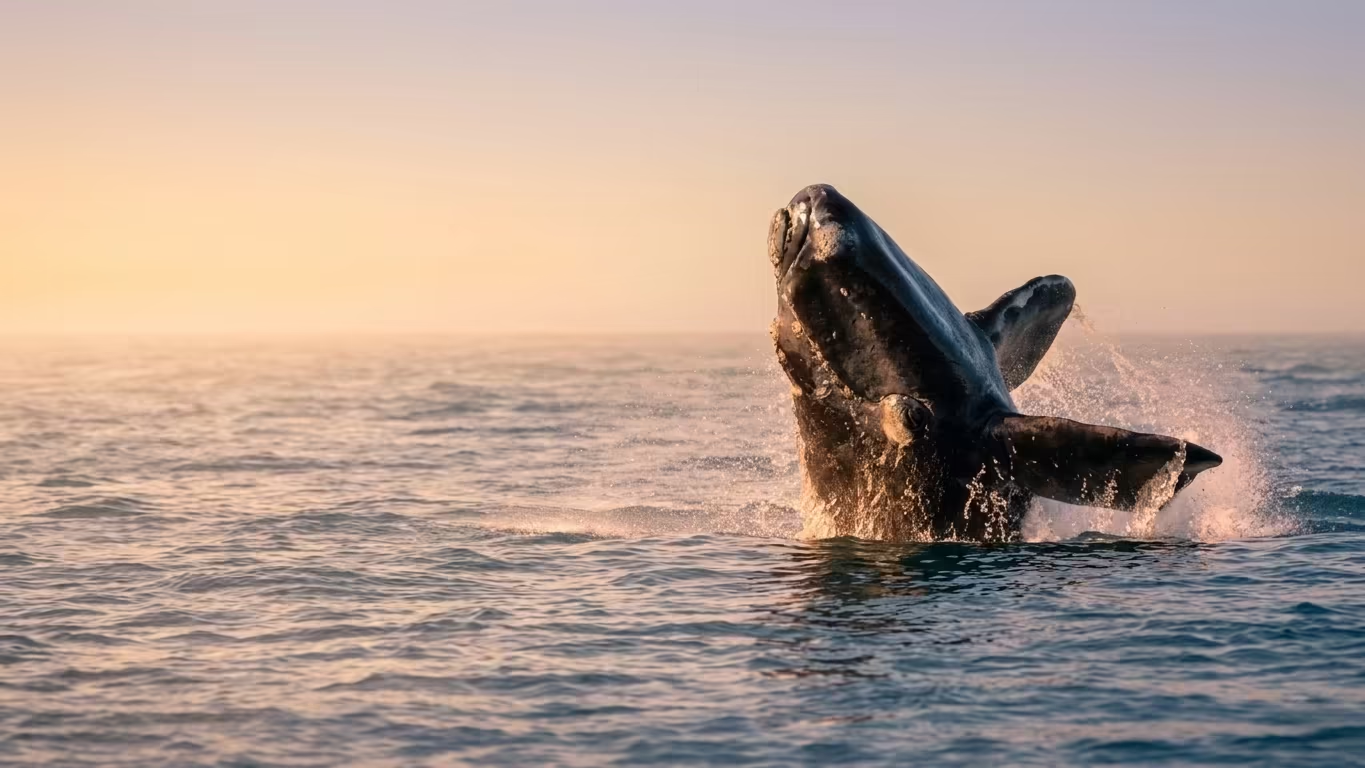
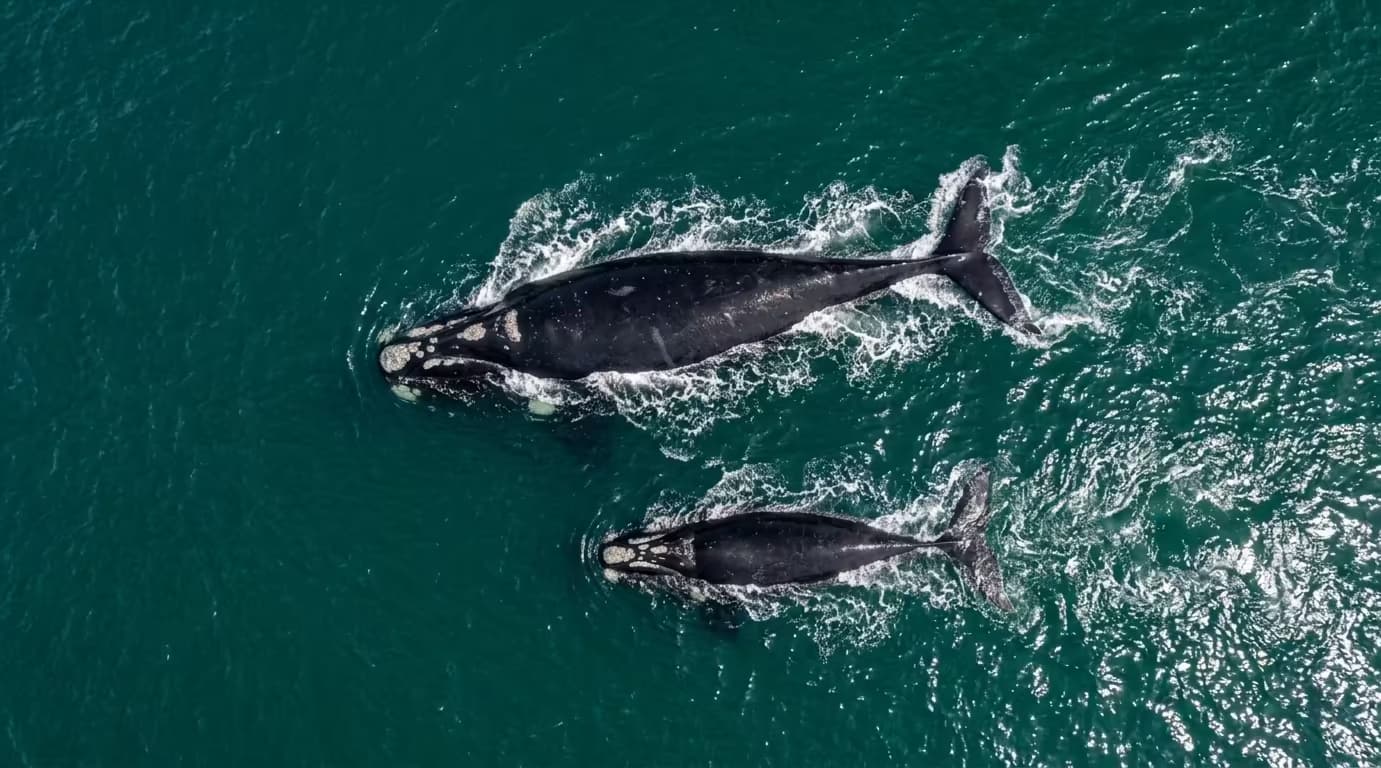
The southern right whale (Eubalaena australis) is one of the largest mammals on the planet — an adult can reach 17 metres and 80 tonnes. It is also, behaviourally, one of the most observable species: it swims slowly, spends long periods at the surface, has no dorsal fin (which makes its silhouette unmistakable), and displays a genuine curiosity about its surroundings.
The name "right whale" comes from the whaling era: it was the "right" whale to hunt — slow, it didn't sink when killed, and it had an exceptional layer of blubber. That same docility nearly drove it to extinction in the twentieth century. Estimates point to fewer than 1,500 surviving animals when international protections began.
Today the population is in slow but consistent recovery. The Instituto Chico Mendes de Conservação da Biodiversidade (ICMBio) monitors each season along the Santa Catarina coast, identifying females by their callosities — the hardened skin formations unique to each animal, like a fingerprint. Many of the whales that arrive at Imbituba are known individually. There are females who have returned to the same stretch of sea for decades. There are calves born here who come back as adults.
That is what makes this encounter different from any aquarium or documentary.
July to November: The Watching Window
Whale season at Imbituba generally begins in July and extends through November. Peaks vary year to year, but as a pattern:
July and August mark the arrival of the first females, many already with a newborn calf or in the final stages of labour. These are the months when sightings carry the most emotional weight: small calves still learning to breathe, attentive mothers, bonding behaviours rarely observed in other species.
September and October are the peak density months. The number of animals in the area reaches its highest point, and behaviours become more varied: full breaches out of the water, lobtailing, interactions between animals. This is when sighting probability is at its highest.
November marks the beginning of departure. Females and their grown calves head back south. Sightings become more sporadic but not impossible, particularly in the first half of the month.
The best conditions for watching are a calm sea day, without strong wind, with good visibility. Mornings and late afternoons tend to offer the best light. Days with rough swell reduce the visibility of animals at the surface — not necessarily because they're not there, but because distinguishing them among the waves becomes harder.
| Month | What to expect |
|---|---|
| June | First arrivals, still rare |
| July | First females with newborn calves |
| August | Arrivals continue, mother–calf bonding behaviour |
| September | Peak density — most animals in the area |
| October | Peak density — breaching and tail-slapping more frequent |
| November | Females and grown calves depart, sightings become sporadic |
The Best Land-Based Viewpoints
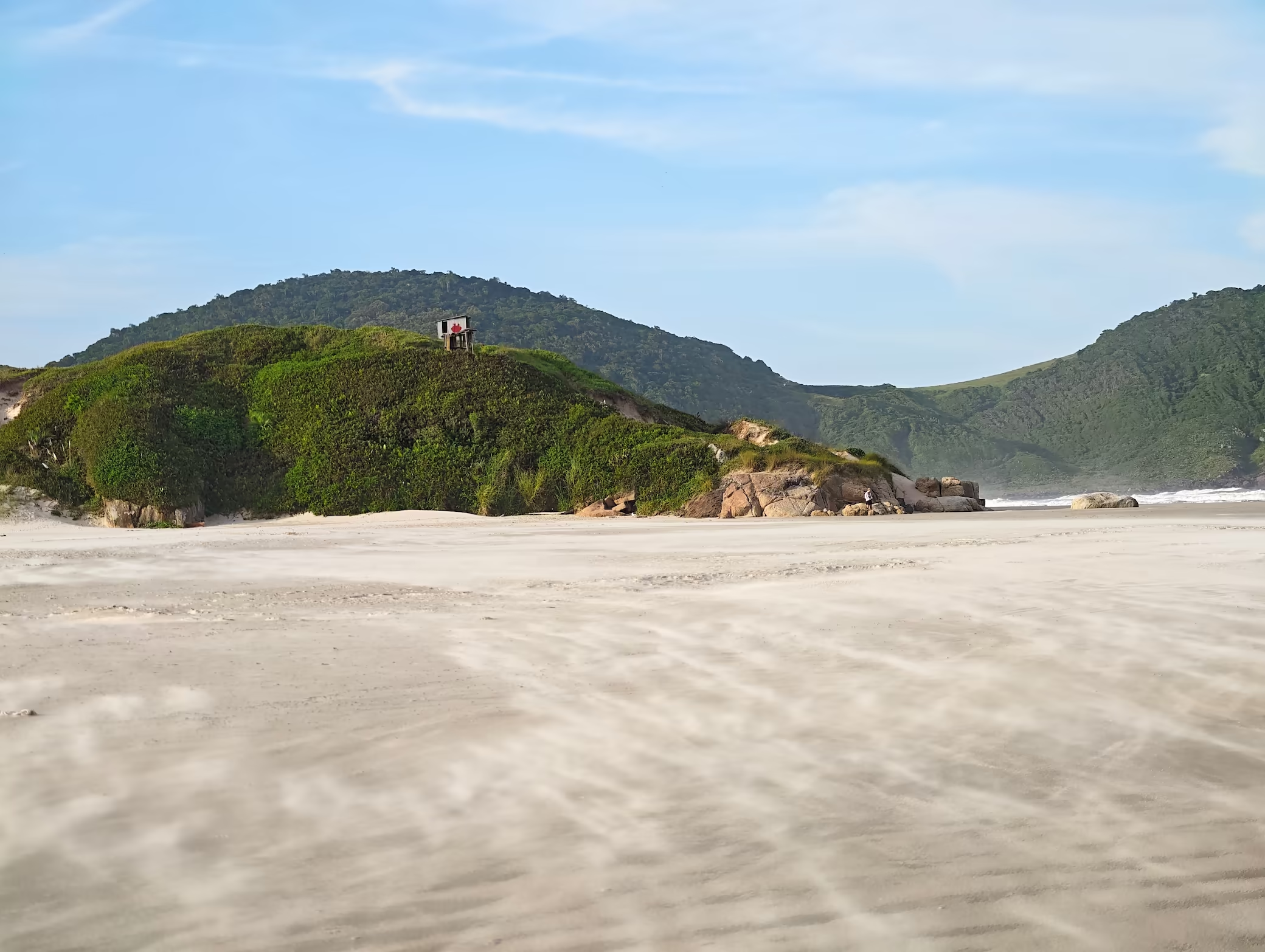
Land-based watching is, in most cases, the most satisfying — and most responsible — way to observe the whales in this region. The coastline has a series of elevated positions that provide a broad view of the marine corridor, with time to follow movements without disturbing the animals.
Praia do Luz — Cliffs and Headlands
In the opinion of many, the finest single viewpoint on the entire coast. The cliffs and hillsides above Praia do Luz reach enough height to provide an elevated perspective over the migration corridor, and the complete absence of infrastructure — no bars, no crowds, no noise — creates a stillness that makes the encounter entirely different. When a whale surfaces in this field of vision, there is nothing else competing for attention.
Access is on foot: via the Mirante do Luz trail from Rosa Sul (~25 minutes), or descending directly from Ibirahill and Morro Elegante (~15 minutes). For Ibirahill guests, it's an early morning walk that requires neither a car nor any planning.
The Dunes Between Luz and Ibiraquera
The dune formations between Praia do Luz and Ibiraquera rise to a useful height and have long been used by local fishermen as elevated observation points for spotting fish shoals from above. That same elevation makes them an excellent whale-watching platform — a less-known vantage point that rewards those who take the time to find it.
Praia da Ribanceira and Praia dos Amores
Praia da Ribanceira sits slightly below road and house level, which paradoxically creates a clear, open sightline out to sea — less obstruction, better horizon. Worth the detour during the season.
Praia dos Amores is in a category of its own. The rocky headland here brings you as close to the whales as you can get from land — animals move through the waters directly alongside the rocks, and the encounters from this particular spot can feel almost private. If you are lucky with timing, there is very little on this coast that compares to it.
Rosa Norte — Hillsides Above the Bay
The hills above Rosa Norte offer a direct view over the cove, where whales frequently enter. There are trails and natural lookout points accessible from the village. The advantage is proximity to infrastructure — easy to combine a morning of whale watching with lunch in Rosa.
Morro Elegante Hillside and the Ibirahill Terrace
From the hillsides above the lagoon — including Ibirahill's position — it is possible to see the sea from multiple angles. The Ibirahill terrace, particularly from the houses with open ocean views, is a legitimate observation point on days of high activity. It is not unusual for guests to see whales without leaving the property. For those who want to look closer, Leo is happy to lend a pair of high-powered binoculars to any guest who asks.
Boat Tour or Land?
Boat excursions operate out of Imbituba during the season. The experience on the water has its appeal — the proximity, the scale of the animal seen at water level — but it also has important limitations.
Brazilian law (IBAMA) prohibits vessels from approaching within 200 metres of the whales and sets rules on speed, noise, and behaviour in the animals' field of vision. Not all operators comply with equal rigour. Boats that approach too closely, or that harass the animals, compromise exactly the natural behaviours that visitors come to see.
Land-based watching, from an elevated position, frequently provides a more complete perspective: you see the animal in context, follow its movement over minutes, understand the scale of the bay and the corridor. There are no emissions, no engine noise, no disturbance.
For those who want to take a boat excursion, the recommendation is to look for operators licensed by ICMBio and to ask explicitly about their approach protocol. Our guide lists Avistamento da Baleia Franca and Ao Sul Natural Turismo, with contact details and location.
How to Watch Responsibly
Southern right whales are in their most vulnerable reproductive phase when they are on this coast. That vulnerability is what makes the encounter so moving — and respect for it is what separates a memorable sighting from a disturbance with real consequences.
A few simple principles:
On land: Keep quiet at observation points. Don't shout or make noise when animals surface. If you have children with you, brief them beforehand.
In the water: Don't swim or kitesurf deliberately toward sighted animals. A southern right whale is not aggressive, but it is enormous — and a female with a calf is, understandably, protective.
With a camera: Drones are prohibited in the protection area without specific authorisation. Do not attempt to fly drones near whales — it is illegal, and genuinely disturbing to the animals.
The encounter doesn't need to be forced to be extraordinary. Whales surface because they need to breathe — and they do so with a regularity that, given patience, makes a sighting almost certain.
Ibirahill and the Whales
Ibirahill's position on Morro Elegante — between the lagoon and the ocean, on the hillside above Praia do Luz — was not chosen by accident. The view from the houses covers the marine corridor where the whales move for months. In good conditions, watching begins on the terrace, with morning coffee.
For guests who want to explore the coast's best observation points, the fifteen-minute walk to Praia do Luz and the ten-minute drive to Praia do Rosa make Ibirahill the best-positioned base in this region for living the whale season with depth — not as a day trip, but as the backdrop to several days.
→ Explore our houses and check availability for the July–November season at ibirahill.com/casas. For questions and planning, get in touch.
Read Also
- The Complete Guide to Ibiraquera, Brazil — Beaches, Lagoon & Hidden Paradise
- Praia do Luz, Imbituba: The Beach That Still Belongs to Itself
- Best Time to Visit Ibiraquera: Month-by-Month Guide
- 10 Hidden Beaches Near Imbituba, Brazil: A Local's Guide
Frequently Asked Questions
Q: What months can I see whales in Ibiraquera and Praia do Rosa? A: Southern right whale season runs from July to November. September and October bring the highest density of animals and the most varied behaviours — breaches, lobtailing, interactions. July and August are the most emotionally charged months: newborn calves and mothers staying very close to their young.
Q: Is it guaranteed to see whales during the season? A: There are no guarantees in nature, but the odds are very high. Imbituba is one of the most important breeding corridors for this species in the South Atlantic, and in good sea conditions it is common to spot animals from land on several consecutive days. Calm mornings with flat sea are the best conditions.
Q: What is the best whale-watching viewpoint in this region? A: The cliffs above Praia do Luz offer the finest elevated positions — no infrastructure, no noise, direct sightlines onto the marine corridor, accessible from Ibirahill in 15 minutes on foot. Praia dos Amores is exceptional for close encounters from the rocky headland. Rosa Norte has natural lookouts over the cove, with easier access but more company at peak season.
Q: Are boat excursions worth it? A: They can be a valid experience with responsible operators, but land-based watching is often superior in quality and always more responsible. Brazilian law sets a minimum distance of 200 metres for vessels; not all operators respect this. From an elevated position on land, you see the animal in full context without disturbance — which frequently results in more natural and prolonged behaviour.
Q: Can I see whales from Ibirahill? A: Yes. The terrace of the Ibirahill houses looks out over the marine corridor where the whales move. In good visibility and calm sea, sightings from the property are frequent during the season. For a closer look, Leo is happy to lend a pair of high-powered binoculars. Praia do Luz, fifteen minutes on foot, offers the most privileged position in the region.
Keep exploring
- Praia do Rosa in the off-season — whale season overlaps the quietest window of the year.
- Atlantic forest in Ibiraquera & Praia do Rosa — the biome that shelters the bay.
- Birdwatching guide — another observation worth combining with whale season.
Stay on Praia do Rosa? At Ibirahill, on Morro Elegante (Ibiraquera), three private houses 10 minutes from Praia do Rosa and 3 from Praia do Luz. See the three houses of Ibirahill in Ibiraquera — rates and availability direct with the host.
Frequently Asked Questions
Q: When is whale season at Praia do Rosa? A: Season runs from June to November, peaking in August and September. First arrivals appear in mid-June; last sightings occur in November. Imbituba has the highest density of mother-calf pairs on the South American Atlantic coast.
Q: Where can you see whales near Praia do Rosa? A: The best spots are the Imbituba headland (inside Parque Estadual Baleia Franca), Ibiraquera beach, and the Mirante do Luz viewpoint. None require a boat — whales frequently appear within 200 metres of the sand. From Ibirahill all three are 2–5 minutes by car.
Q: Can you take a whale-watching boat trip near Praia do Rosa? A: Boat tours operate from Imbituba and Laguna, but regulations prohibit vessels within 200 metres of whales. Headland and beach observation is equally effective — and free.
Q: What whale species appears in Imbituba and Ibiraquera? A: The southern right whale (Eubalaena australis). Adults measure 12–18 metres and weigh 40–80 tonnes. They travel from Antarctica to give birth and nurse calves in the shallow, protected waters of the Santa Catarina coast.
Q: Does whale season coincide with the low tourist season? A: Yes. June through September is low season in Ibiraquera and Praia do Rosa — fewer visitors, lower prices, quieter beaches. It is the combination favoured by travellers who want whale sightings without crowds.