The firepit ritual at Ibirahill, Ibiraquera: cold nights
Quick answer
The firepit ritual at Ibirahill is an open-air evening gathering that sets the pace of a stay in Ibiraquera: as the sun sets, guests collect around a wood fire with no agenda and no scheduled entertainment. Nestled between Atlantic Forest and Praia da Luz, Ibirahill holds the fire as a central part of its slow-living philosophy — an invitation to silence, unhurried conversation, and the sounds of the forest. Guests consistently name the fireside evenings among the most memorable moments of their stay.
In summary
- 🔥 What it is: open wood fire gathering at dusk — no agenda
- 📍 Where: Ibirahill, Ibiraquera — Atlantic Forest meets Praia da Luz
- 🕐 Time: from sunset (~6 pm in Santa Catarina)
- 👥 Access: guests of Ibirahill only
- 🌿 Philosophy: slow living — unhurried time, silence, nature connection
- 🚗 Distance: 3 min from Praia da Luz; 10 min from Praia do Rosa
- 🏨 Book: ibirahill.com — boutique stay in Ibiraquera, SC
"A fire isn't entertainment. It's where time slows down and contemplation arrives."
When the Wind Changes
There is a moment, usually between late April and early June, when the evenings in Ibiraquera stop being warm. It isn't real cold — this is the Santa Catarina coastline, not the highlands — but the wind that rises from the Atlantic after sunset starts asking for a sweater, socks, a third layer before stepping onto the terrace. The sound of the Atlantic Forest shifts: the summer insects give way to a deeper quiet, broken only by the sea, which now feels closer.
This is the time of year when the firepit in Ibiraquera becomes, for those who live here, the most obvious gesture of the day. Not an event. Not an activity. It's simply what you do because the nights ask for it, because the wood is dry, because the nature around you invites you to stop.
What is the firepit ritual at Ibirahill? It is a slow, simple practice of lighting an outdoor fire between the end of the afternoon and the start of the evening, as a gathering point. In Ibiraquera, between autumn and winter (April to August), the firepit works as a sensory and social anchor — warmth, woodsmoke, the sound of embers, and the view of the Atlantic Forest in silence.
The Power of the Firepit
A firepit needs no elaborate justification. It is heat and light, and those two things create, without effort, the thing architects and designers spend decades trying to design: a centre. Where there is fire, there is a place. Those who approach, stay. Those who pass, linger.
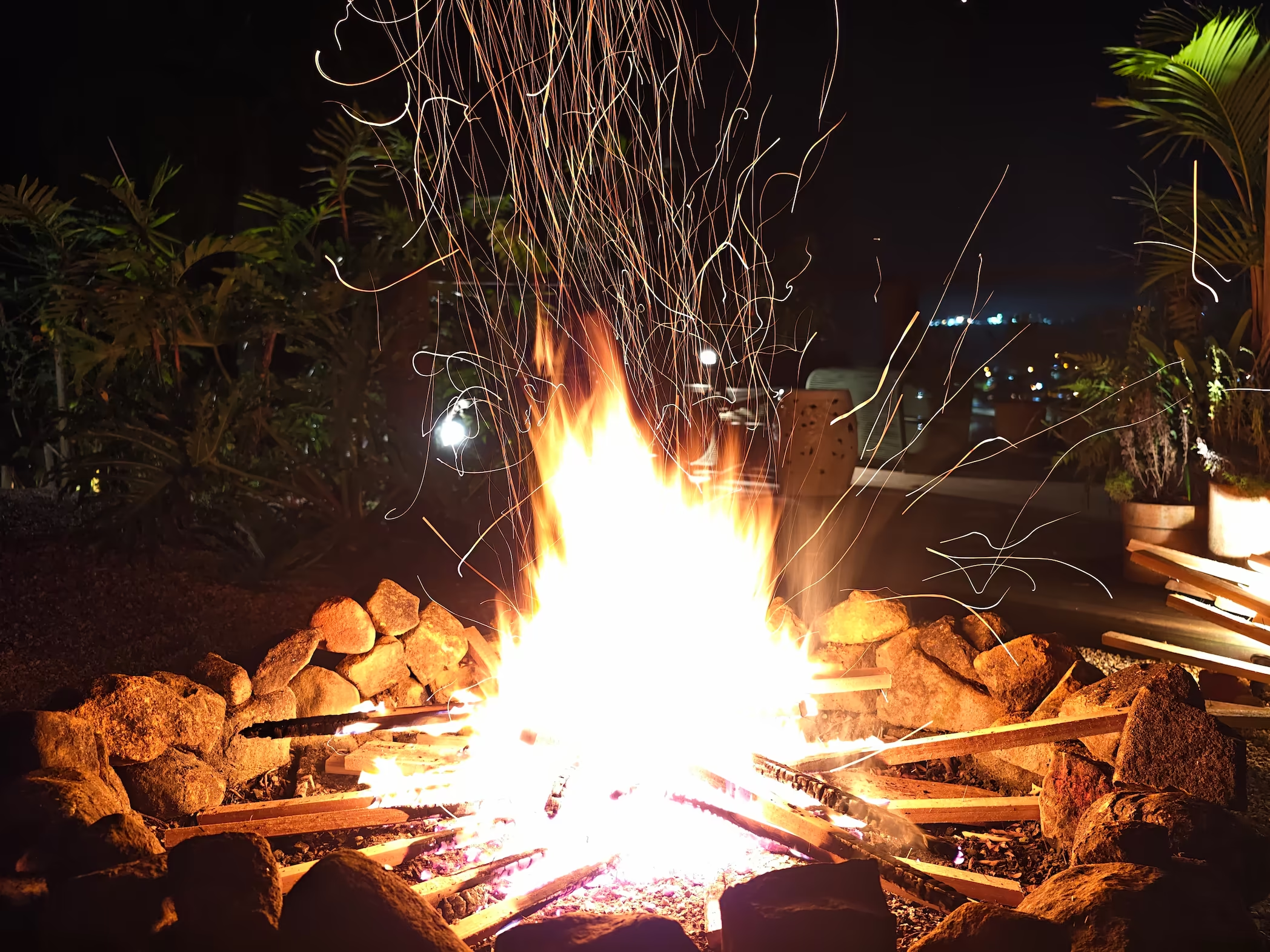
What surprises — and anyone who has lived in Ibiraquera for a while knows this — is how much of the experience isn't visual. It's the smell of the wood as it begins to catch. It's the uneven crackle that interrupts a sentence mid-thought. It's the warmth on your face against the cold at your back — a specific sensation of an outdoor night that simply cannot be replicated in a heated interior.
And then there is what fire does to the other senses: it darkens everything else. When there are flames in front of you, peripheral vision dims, and the world contracts to the circle of light. In a place like Ibiraquera, where the native Atlantic Forest begins metres from the terrace and the ocean is just behind, that contraction is a relief. The landscape is so much during the day that a night around fire becomes, by contrast, a kind of retreat.
What the Fire Lets You See
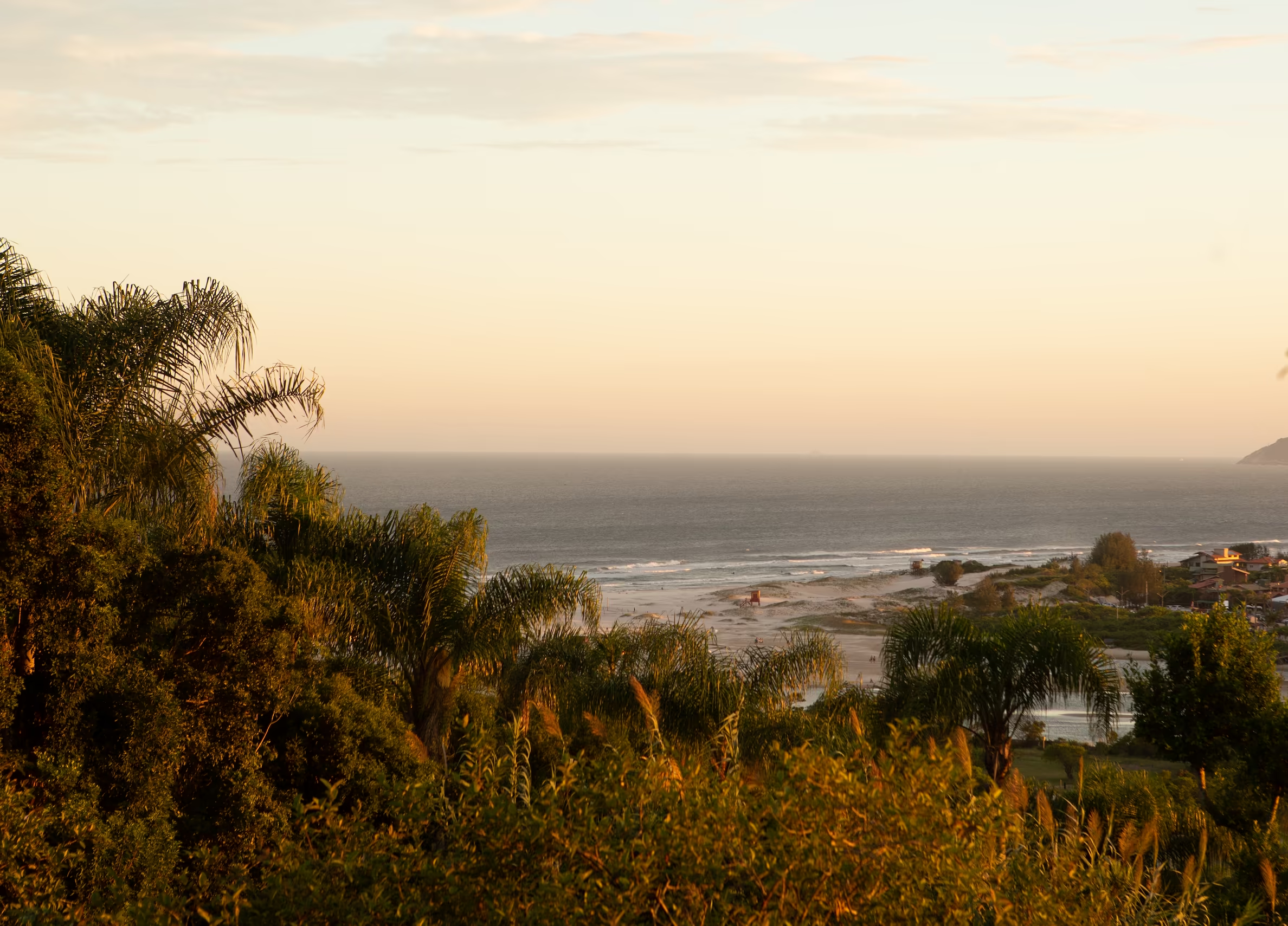
The contradiction of a firepit is that it darkens the terrace and opens the sky. Once your eyes leave the flames and lift, what comes back is what no city night gives you any longer: the southern hemisphere's sky, in full. The Cruzeiro do Sul rotates above the line of the forest. Between May and August, the arm of the Milky Way crosses the terrace from south to zenith. There is no streetlight between the fire and the horizon — and no horizon, in fact, that is not Atlantic or Mata Atlântica.
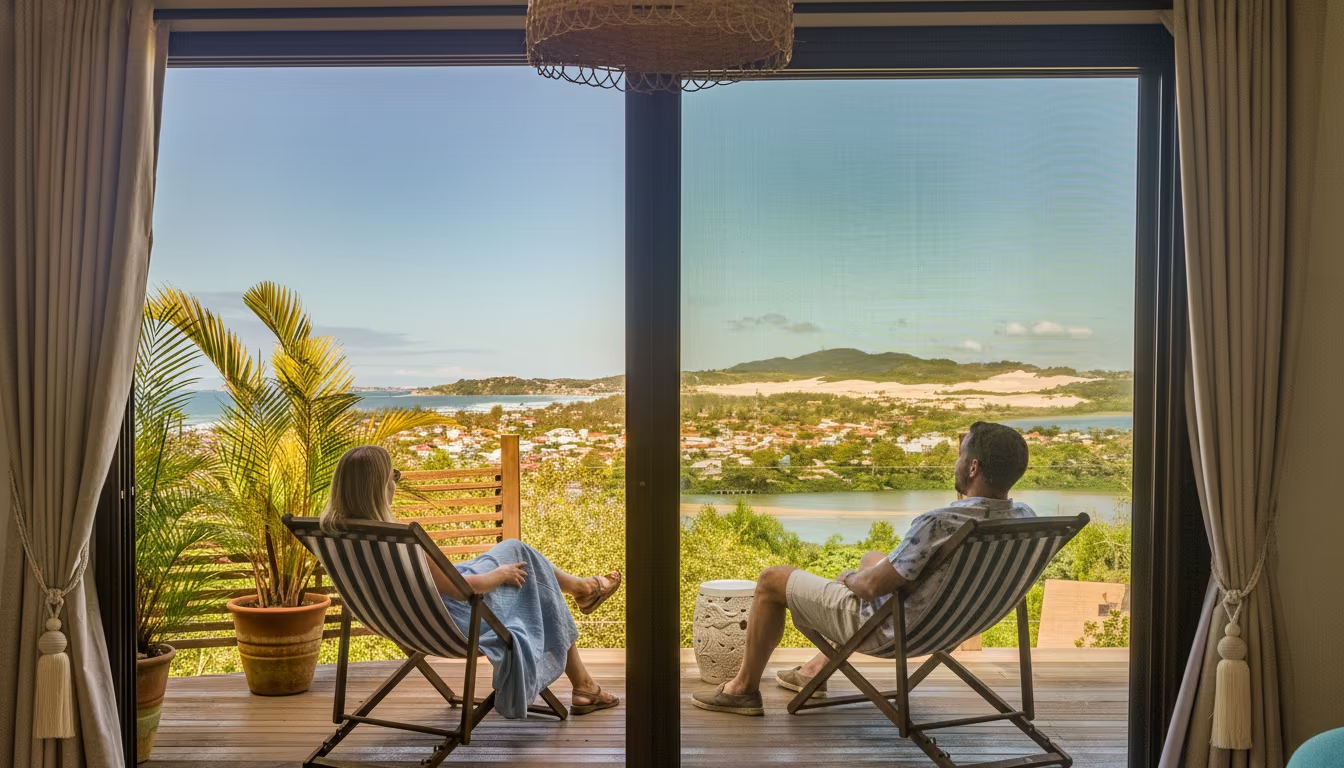
And below, in the same field of view, the mist works its own quiet hours. From the upper deck of Casa Galeria, on most autumn and winter mornings, you watch the bruma settle into the Lagoa de Ibiraquera and the low pasture — a slow white sea that erases the roads and reveals only the tops of the hills. After dark, when the fire is going and the moon is up, the same mist returns as a luminous floor beneath the stars. Day or night, this view is the part of Ibiraquera that no photograph manages to carry home.
A firepit, held next to the night sky and the weather of a coastal valley, is an old technology in good company. The Tupi-Guaraní who named these forests knew it; the Azorean fishermen who settled this coast still know it. Fogo de chão — fire on the ground — is an ancient tradition that feeds the soul precisely because it is small enough to let everything else around it become large again.
Founder's Perspective
In my first stays here, in 2017 and 2018, before Ibirahill existed as a project, I learned the value of a firepit by accident.
We had come from London, where winter is a prolonged enemy fought with central heating, double glazing, and a continuous effort to exclude the outdoors. In Ibiraquera, I discovered the opposite: the cold here isn't a threat — it's an invitation. The house asks to be left behind. Even at 14ºC, the outside is more welcoming than the lit sitting room.
I remember the day we lit the first fire on the hill, using leftover formwork timber from the build of the first house. We stood there and saw it clearly: each house needed this. The thing itself is phenomenal.
Today, when a guest arrives in autumn or winter and asks what there is to do in the evening at Ibirahill, my answer is almost always the same: nothing. Light the fire at the end of the afternoon, watch the sunset and the night come in while the food roasts. And in seven years, nobody has ever complained that it was too little.
A local's tip: between May and August you will find fresh tainha at the fishmongers — perfect for roasting over the firepit.
The Firepit at the Houses of Ibirahill
Two of the houses at Ibirahill have an outdoor firepit.
Casa Ateliê has the larger fire, with a gaúcho tripod grill for those who want to turn the evening into a proper churrasco — comfortable for up to four people.
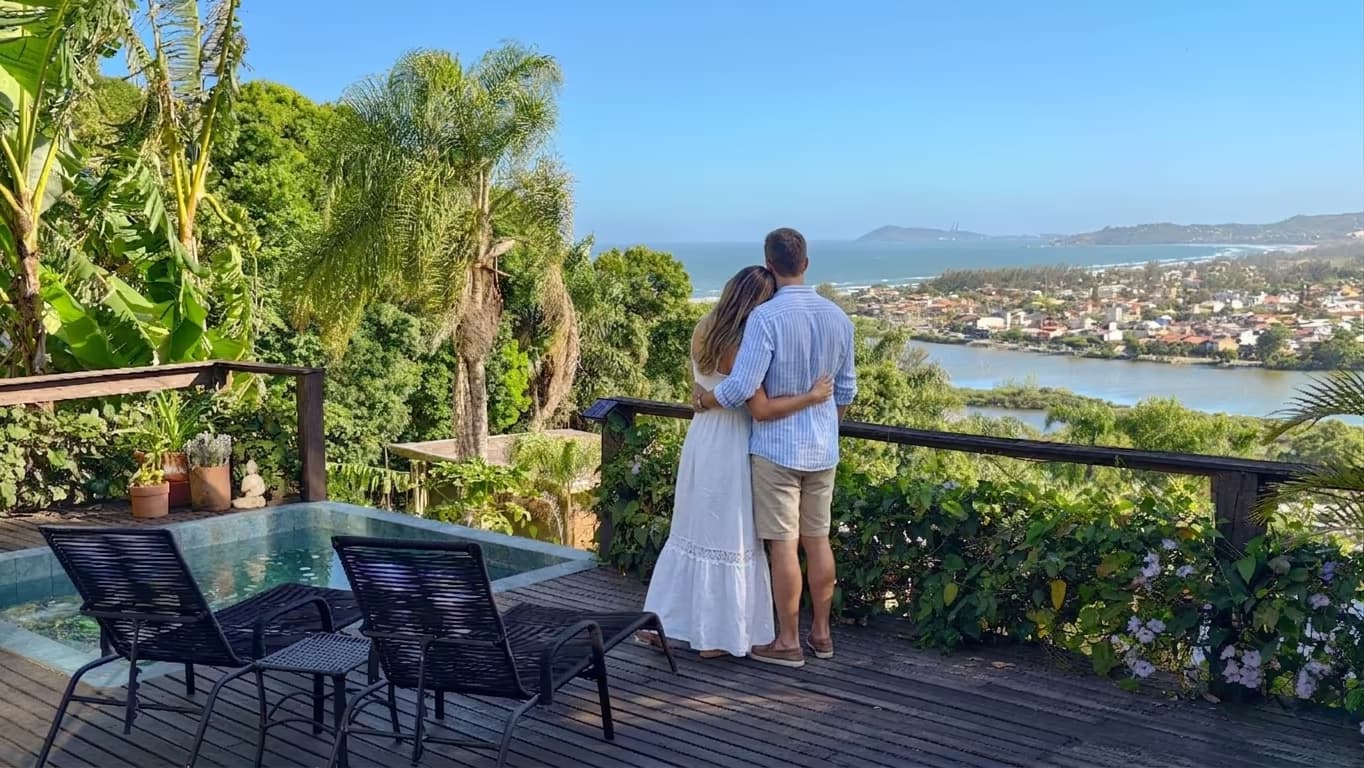
Casa Bajau has a smaller firepit — for two — also facing the lagoon, with loungers set close enough to bridge the forest and the water, in the way of older rituals.
The Firepit Season in Ibiraquera
The firepit in Ibiraquera is a year-round ritual. Summer (December to March) is warmer, but it still allows for a smaller fire — enough for a churrasco and an unhurried moment. It is in the colder months — April, May, June, July, August — that the fire enters naturally.
This period overlaps with other layers of local life that the curious guest can follow: the tainha season in May and June, when fishermen watch the sea from headlands above Praia do Luz; the arrival of the first southern right whales in July; the nights growing more starlit as summer's humidity gives way.
For anyone planning a stay around this, our guide to when to visit Ibiraquera details the months and the conditions. The personal recommendation is May and June: cold enough for the fire to matter every night, without the severity of the Catarinense highlands, and with the coast's natural phenomena just beginning to open.
→ To book an autumn or winter stay in one of the Ibirahill houses, see availability or get in touch directly.
Frequently Asked Questions
Q: What is the firepit ritual at Ibirahill? A: It is an end-of-day ritual in which a fire is lit outdoors, on the terrace or garden of each house, during the cooler months (April to August). It isn't a barbecue or a scheduled event — it's a slow practice of being together around the fire, with local wood, the Atlantic Forest in view, and the ocean behind. It serves as the anchor of evenings in Ibiraquera.
Q: What time of year does a firepit make sense in Ibiraquera? A: Between late April and early August, when Ibiraquera evenings drop below 18ºC and the Atlantic wind asks for a second layer. May and June are the ideal months: cold enough for the fire to matter, without the harsher climate of the Catarinense highlands. In summer the fire doesn't make sense — the evening experience in Ibiraquera is simply something else.
Q: Do all three Ibirahill houses have a firepit? A: No. Only Casa Ateliê and Casa Bajau have their own firepit integrated into the garden — each with a different orientation and character. Dry, sustainably sourced firewood is sold at every market in the region.
Q: Can I light the fire myself or is supervision required? A: Guests light their own fire — that is part of the ritual. The first evening always includes guidance from someone at the house, to explain the wood, the order, and the wind at that particular spot. After that it is free. Fires are always contained in their structure, and there is a simple extinguishing protocol at the end of the night.